
Crisis Management Is an MC's Highest Skill — Which Is Why I Still Use Paper Cue Cards


Recently, a dispute about MC professionalism has been making the rounds online. One point of contention: the client asked the MC to use hard-copy cue cards, while the MC said reading from a phone would do.
Both sides have their own accounts, and nothing has been independently verified — I'm not here to judge. But the question at the centre of it deserves serious thought from anyone who works, or wants to work, as an MC.
My own practice may sound a little old-school: to this day, I still use paper cue cards.
Not out of stubbornness. When you've been hosting long enough, you come to understand one thing — what's most valuable on stage isn't technique. It's *nothing going wrong*.
1. Crisis Management Is the Higher-Order Skill
A good voice and steady stage presence matter, of course — those are the fundamentals. But stay in this profession long enough and you'll discover: what truly sets MCs apart is the ability to handle a crisis.
The run-down suddenly changes, a guest is late, a microphone dies, the award list is amended at the last minute — the moments the audience never sees are the real test. The fundamentals get you onto the stage; crisis management keeps you standing on it.
And this higher-order skill doesn't begin when things go wrong. It begins with how you prepare — preparation is the first layer of crisis management.
So I work by one principle, and it runs through every choice I make:
> Anything that could create a crisis, I avoid using.
A tool may work beautifully ninety-nine per cent of the time. But if there's a one-per-cent chance it fails at the exact moment you can least afford it — for an MC, it isn't worth it. On stage, there is no take two.
The case for paper is simple: it has no battery, no notifications; it won't sleep, won't glare, won't suddenly rotate.
Some say paper is troublesome to amend. Honestly, once you're used to it, it isn't — a last-minute change means reprinting one or two cards. A small price, compared with a device dying on stage.
2. Cue Cards in Practice: What I Teach My Students
Many people think cue cards are just "the script, printed out." In fact, a few details make all the difference — get them wrong and you might as well not have bothered.
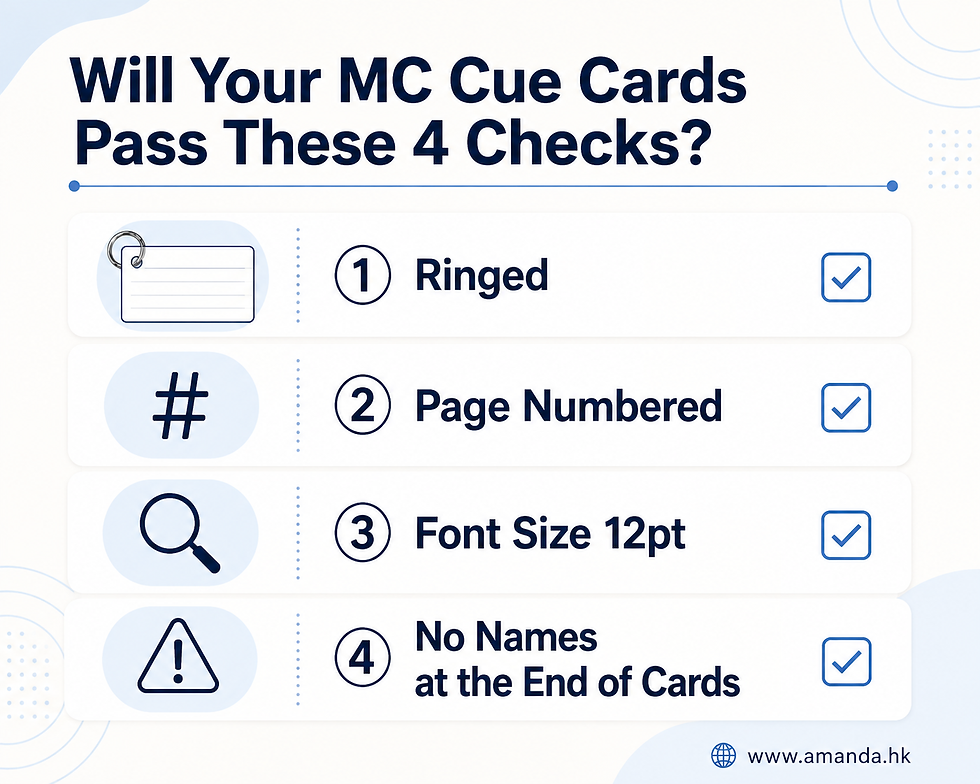
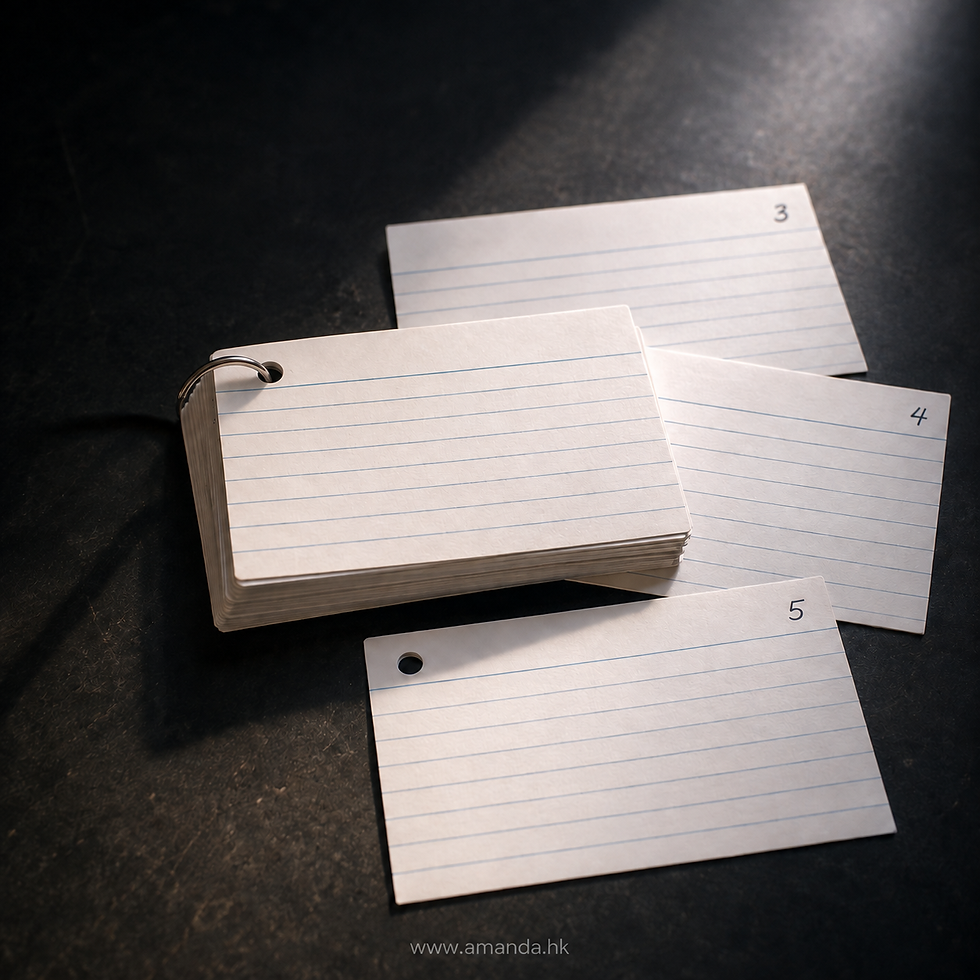
① Always bind them with a ring: because the order must never change
This is the step new MCs most often skip.
Many assume the ring is for flipping cards one-handed — and that is a genuine benefit, since an MC's other hand is usually holding the microphone. But convenience isn't the real reason.
The real reason is that the ring locks the sequence.
Each time you finish a card, you move it to the back. That small motion is where things go wrong: the stage is dim, your attention is on the audience, and one misplaced card breaks your next line. With a ring, the order can never change, no matter how many times you flip.
② Always number the cards — this once saved me mid-show
Even with a ring, you need page numbers. Because rings can snap. That's not theory; it happened to me.
I was hosting a charity gala when the ring on my cue cards suddenly broke, and the whole stack scattered across the floor. My volunteer MC team rushed out from backstage to gather them up.
Thankfully, every card carried a sequence number — no one needed to read the content or ask me anything. They simply sorted by number, and within moments the stack was back in my hands, in perfect order.
And if those cards hadn't been numbered? A pile of similar-looking cards, scattered on the floor, needing to be re-ordered live on stage — those few seconds would have felt infinite.
③ Font size: 12pt recommended, never below 10pt
These are field-tested numbers. I recommend 12pt as the norm; below 10pt, nerves make misreading far too easy.
The you on stage and the you proofreading at home are not the same person. At home you're seated, well-lit, calm; on stage you may be standing in shadow, lit from an angle, heart racing. Size your text for the you on stage, not the you at home.
Naturally, those blessed with exceptional eyesight can make their own call. But never design your safety net around your best condition.
④ Never leave critical information at the bottom of a card — carry it over to the next
In general, content simply follows the run-down from card to card. There's no need to limit each card to a single item — you'd end up with more cards than you can manage.
But one exception must be observed: names, titles, award names — anything you cannot afford to get wrong — should never be squeezed into the tail end of a card. Let it carry over to the top of the next card, laid out clearly.
The reason is practical: the one thing you never want mid-announcement is a page turn. The page turns, your eyes leave the text, the rhythm breaks — and a misread name is one of the hardest mistakes for an MC to recover from.
3. So Are Digital Systems No Good?
Not at all. Let me be clear about this.
Digital systems have real advantages: instant edits, no reprinting, every event on one device. And an iPad is not a phone — an iPad won't interrupt you with an incoming call, which is a significant difference.
A seasoned MC is perfectly capable of running a digital setup, and where the client agrees, using one is simply how the profession moves with the times. I've never believed tools themselves are right or wrong.
The difference lies not in the tool but in the backup plan. An experienced MC who reads from a tablet runs a full protocol behind it: flight mode, screen always-on, full charge, a power bank — and a paper copy waiting in the wings. They're not "using a tablet"; they're using a tablet *plus complete risk management*.
As a trainer, though, my advice is unambiguous: new MCs, start with paper.
Not because paper is superior, but because a new MC already has enough to handle on stage — the run-down, the diction, the nerves, the thinking on your feet. At this stage, managing a device is one burden too many.
Once you can do it all with your eyes closed, use whatever you like.
4. A Closing Word
Paper or digital — practices vary across the profession, and the debate will no doubt continue.
I'm not out to convince everyone. All I can say is this: after more than 1,500 events, I still use paper cue cards — and I advise my own MC students to start with paper too.
This profession, from beginning to end, sells one thing: reliability. And I let nothing that could create a crisis onto my stage.
Frequently Asked Questions (FAQ)
Q1: Must an MC use paper cue cards? Is an iPad or phone acceptable?
There's no hard rule. Experienced MCs manage perfectly well with tablets — but they typically run full risk management: flight mode, screen always-on, ample battery, a power bank, and a paper backup on standby. The difference lies not in the tool but in whether a backup plan exists. For new MCs, paper is the recommended starting point — there's already enough to handle on stage without managing a device.
Q2: How should cue cards be prepared?
Four field-tested essentials:
① Bind them with a ring — above all to lock the sequence so cards can't be misplaced when moved to the back, and to allow one-handed flipping when needed.
② Number every card, so a scattered stack can be restored in seconds.
③ Use 12pt type as the norm and never below 10pt — nerves on stage make small text easy to misread.
④ Keep names, titles and other critical details away from the bottom of a card; carry them over to the next card instead, so you never turn a page mid-announcement.
Q3: How should content be arranged — one item per card?
No. Content should simply follow the running order from card to card; one item per card creates an unmanageable stack. The single exception: names, titles and award names — details you cannot afford to misread — should never sit at the tail of a card. Carry them to the top of the next card, so an announcement is never broken by a page turn.
Want to Build Stage Confidence from Your Very First Cue Card?
My Signature MC Training Course starts from zero and covers run-downs, stage presence, thinking on your feet, and professional standards — including every detail in this article.
Learn about the latest cohort and enrolment: https://www.amanda.hk/en/mc-training-workshop
Updated 2026
About the author | Amanda Fok
Hong Kong's "MC Godmother," a professional MC training mentor and ADHD coach, and an ADHD person herself. Champion of Hong Kong's first-ever territory-wide MC competition, with over 1,500 MC and hosting engagements and more than 10,000 students trained, she has authored and been lead writer on several books on MC work.
Amanda Training


Comments